Then & now
1868
An early instant gas water heater appears in England
- From Roman baths to wall-mounted tankless
- U.S. homes with tankless: 1% to 6.5%
- How to make modern equipment last
A Mr. Tankless field guide · Then & now
From Roman bath furnaces to today’s wall-mounted tankless systems, hot water has always been an engineering story. Here’s how we got here, and how to help modern equipment last.
Then & now
1868
The timeline
There’s no single “first water heater.” People heated water long before written records, but a few milestones stand out.
Bathhouses used a hypocaust to circulate hot air below floors, and the same furnace could heat water held in a tank for the hot bath.
Benjamin Waddy Maughan’s gas “geyser” is widely credited as an early domestic instantaneous water heater.
Engineer Edwin Ruud developed an automatic gas storage water heater, putting stored hot water within reach of more homes.
Insulated tanks, thermostats, safety controls, and gas or electric heat made hot water an everyday expectation.
Modern sensors and heat exchangers bring instantaneous heating into a compact, controlled appliance.
A shift in American homes
Share of occupied U.S. homes reporting a tankless main water heater in the EIA’s Residential Energy Consumption Survey. These are survey snapshots, not annual sales.
Efficiency & lifespan
In high-use homes, around 86 gallons a day, the DOE estimates an 8–14% advantage. Actual savings depend on the model, fuel, draw pattern, and installation.
A well-maintained tankless heater can last 20+ years, versus roughly 10–15 for a typical storage tank, though no individual unit is guaranteed to reach that age. Efficiency also isn’t the same as a guaranteed cut in your utility bill.
Choose the fuel that fits
Natural gas is often a practical whole-home choice where gas service exists, but the lowest total cost depends on utility rates, sizing, venting, and upgrade costs. We assess the actual house first.
Strong capacity for multiple fixtures; condensing models recover more heat from exhaust. Needs correctly sized gas piping, approved venting, and often a condensate drain. Best when your home already has suitable gas service.
Similar combustion-based operation where utility gas isn’t available. The tank, deliveries, fuel pricing, and approved venting all enter the overall cost.
No combustion vent, and compact for a sink or modest demand. Whole-home units can need substantial electrical capacity, especially with cold New Jersey inlet water.
Make it last
In parts of northern New Jersey, hard water leaves calcium and magnesium scale behind. The right treatment starts with your local water report and, where useful, a hardness test.
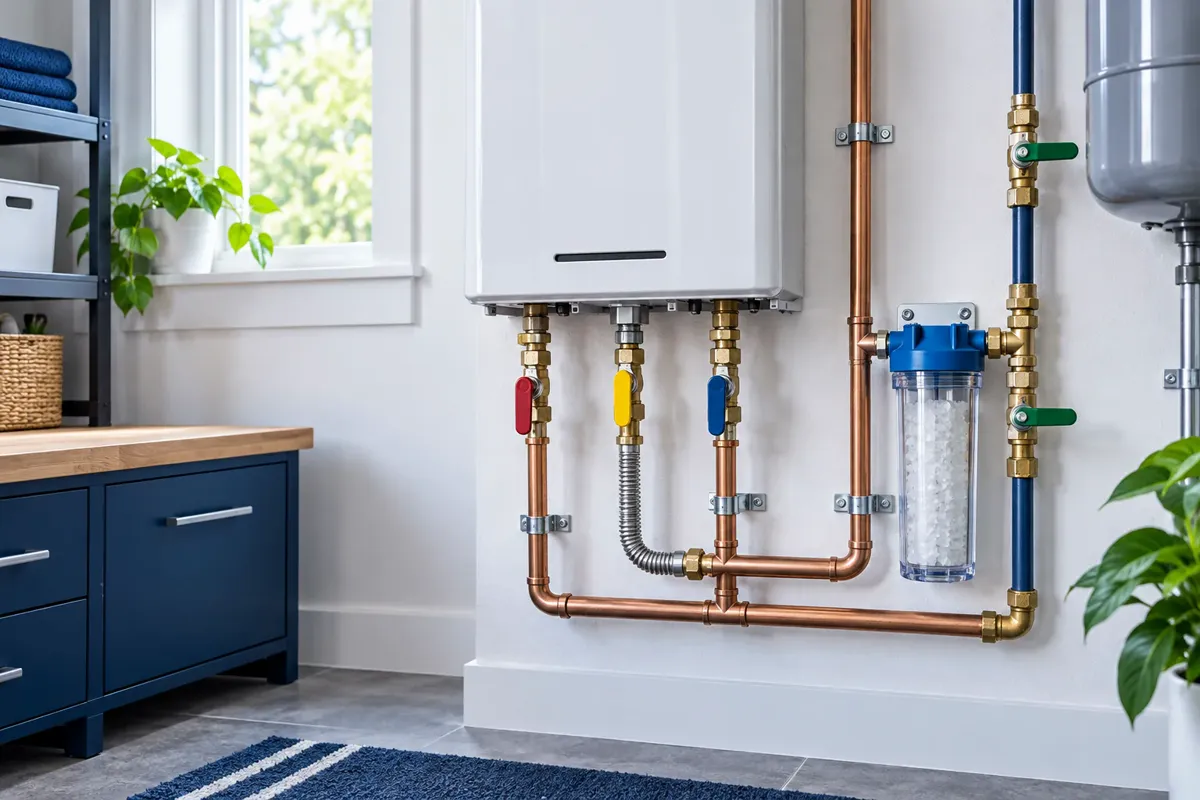
One option is the 3M Aqua-Pure AP430SS scale-inhibition system on the cold-water feed. It doses polyphosphates that help keep hardness minerals from depositing on hot surfaces. It isn’t a filter that catches calcium or a substitute for a softener where the heater maker requires one, and its cartridge generally needs replacing every six months, or sooner if flow drops.
Like descaling a coffee maker, professional flushing circulates a manufacturer-approved solution through the heat exchanger. The DOE says intervals range from twice a year to once every three years, depending on the manufacturer and conditions.
Tankless maintenance
Ignoring scale can restrict flow, reduce performance, and shorten service life. A sensible visit covers:
Make it affordable
Flexible financing, utility rebates, and current promotions help make the work your home needs fit your budget.
Quick approval with a soft credit check that won’t affect your score.
Explore financingUp to $750
Qualifying energy-efficient upgrades may be eligible. We’ll help you find out.
Check rebates10% off any service for new customers, $299 water heater maintenance, and more.
View promotionsCustomer reviews
“From the first phone call to the final installation, he was responsive, professional, and transparent about the process and prices.”
“We contacted Mr Tankless around 3 PM in the middle of a heat wave. Howard was at our house before the end of the day and we had a new AC unit in 48 hrs!”
“I called Howard at 10:15 this morning and by 2:00pm I had a new thermostat installed and a/c running!”
Ready when you are
Talk to a real person today. You’ll get honest advice, an upfront price, and work done right the first time.